Can you really tell the difference between a £700 limited-edition KitchenAid and an £79 stand mixer?
The Salter British Stand Mixer will make and bake all your best culinary endeavours

Stylish and budget-friendly, this is the perfect stand mixer for everyday bakes. It boasts an impressive stainless steel bowl, planetary mixing action, and a suite of attachments. Whilst it's slightly slower and noisier than a KitchenAid, it completes the same core tasks for a fraction of the price.
-
+
Exceptional value for money
-
+
Covetable, choc colour
-
+
Stable and easy to use
-
+
Capable across a range of baking tasks
-
-
Struggles to reach the base of the bowl
-
-
Slower and nosier than cheaper models
Why you can trust Woman & Home Our expert reviewers spend hours testing and comparing products and services so you can choose the best for you. Find out more about how we test.

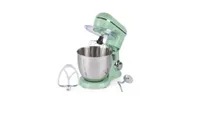
I’ve sworn by Salter’s stand mixers for years. They’ve long occupied that sweet spot between affordability, versatility, and style, but the new British range in green anticipated something much more impressive. It’s not just another pastel refresh. It’s a design move that lands squarely in the middle of a trend currently dominated by one very famous brand: KitchenAid.
Since KitchenAid announced its Colour of the Year in spearmint, excitement around the best stand mixers has escalated sharply. Glossy, retro silhouettes in minty hues have flooded Instagram feeds and kitchen mood boards alike. While I love the engineering, heritage, and performance extras that come with the premium end of the market, I can’t ignore the fact that Salter has delivered the same aesthetic impact for a fraction of the cost.
The obvious comparison to the Salter British Bakes Stand Mixer in green is the KitchenAid Artisan Stand Mixer in the 2026 limited-edition colour, spearmint. It's arguably the best KitchenAid for most home bakers: it's the one I own, the stand mixer that they use on The Great British Bake Off, and a favourite of Kate Middleton and Nigella Lawson too. In spearmint, it costs £699.99. The Salter costs just £79.99. That’s a £620 saving. So the real question isn’t whether they’re identical (they’re not) but whether Salter delivers enough of the look and performance to make that saving feel justified. After extensive side-by-side testing, I have a clear answer.
Salter British Bakes Stand Mixer review

RRP | £69.99 |
Dimensions | 33 x 22 x 35.2 cm |
Power | 1300 watts |
Capacity | 5L |
Settings | 10 speeds |
Warranty | 3 year |
Who would the Salter British Bakes Stand Mixer suit?

I love Salter’s stand mixers, not purely because of the pastel colourways (although that undeniably helps), but because they consistently overdeliver on value. At £79.99, the British range undercuts most 4–5L capacity stand mixers by hundreds of pounds, yet still offers a full accessory suite and a multi-speed planetary mixing action. It also comes with a manufacturer’s 3 year guarantee, which adds reassurance at this price point.
With a generously sized stainless steel bowl (approximately 5L capacity), this is more than capable of handling family-sized batches: think 500g flour bread recipes, 24 cupcakes, or a double batch of cookies. In contrast, many mixers under £100 operate with smaller 3–3.5L bowls.
Based on the price, I always recommend the Salter British Bakes Stand Mixer to first time bakers and people who want a stand mixer but who aren't ready to spend North of £600 on an appliance to help them out. Especially if you want the pastel colour options from Salter; they're a great way to bring bright light tones into your home.
Importantly, the spring-loaded design of the stand mixer is perfect if you struggle with heavy weights in your kitchen. A common complaint levelled against KitchenAids and similar models is that they are heavy to lift, both out of a cupboard and from the top. The Salter is lighter and more compact, so you can place it in higher cupboards and give it to those who might not have as much strength in their wrists.
My only word of warning goes to those planning to knead high-hydration sourdough weekly or batch-produce enriched brioche dough. You may want something with a more robust direct-drive motor system, like KitchenAid or Kenwood (I have a detailed comparison of KitchenAid vs Kenwood on a dedicated page). The Salter is powerful for its class, but it does operate at a slightly lower torque output and you can hear that under strain.
Unboxing the Salter British Bakes Stand Mixer

Salter deserves credit for its packaging. The entire outer box and internal moulding are cardboard-based, and the accessories are wrapped in recyclable paper rather than plastic. For environmentally conscious buyers, this is a welcome departure from the polystyrene-heavy packaging typical in this category. It's actually one of the only brands that can boast this level of sustainability, which, accounting for the price point, is remarkable.
Inside the box you get the main stand mixer base, a 5L stainless steel mixing bowl and then the classic accessories: a flat beater (for creaming and cake batters), a balloon whisk (for aeration and whipping), a dough hook (for yeast doughs), and a transparent splash guard. The instruction manual has diagrams and descriptions to talk you through what's each piece is, but the Salter Bakes British Stand Mixer is also very straightforward.
The attachments are lightweight but solid, with a simple spring-loaded bayonet fitting. The bowl is dishwasher safe (clearly labelled inside), and I was pleased to find the sticker adhesive removed cleanly with warm water, so there's no sticky residue.
Fit and finish are good for the price bracket. The gloss spearmint casing has a smooth enamel-style coating, and the control dial offers clearly defined speed increments with tactile resistance. It makes for a very lovely first impression.
What is the Salter British Bakes Stand Mixer like to use?

The Salter Bakes British Stand Mixer uses a tilt-head mechanism with a release lever at the side. The head is spring-assisted, so lifting it requires minimal force. This makes attachment changes quick and intuitive.
All accessories twist into place via a spring-loaded shaft. It’s not as heavy-duty as the KitchenAId Artisan’s all-metal hub, but it’s secure and easy to operate.
The bowl locks into the base with a rotational click system and can be positioned freely since it doesn’t have a fixed handle. I actually see this as a useful feature, although I know plenty of people like to have a handle to secure a solid grip on their bowl when pouring and transferring mixtures between the bowl and cake tins. It's also worth noting that the controls sit on one side only, so positioning on your worktop matters.
The suction “sticky feet” on the Salter Bakes British Stand Mixer also deserve special mention. They create excellent surface grip, reducing lateral movement during thicker mixes, particularly impressive given the lighter chassis.

Bread is the real stress test for any stand mixer, so I like to dive straight in. I made a 500g white country loaf (roughly 60% hydration) in the Salter Bakes British Stand Mixer and was very impressed. Initially, the dough came together cleanly on low speed. After 6–8 minutes of kneading, gluten development was visible: the dough formed a cohesive ball and passed a partial windowpane test.
Side by side with the KitchenAid Artisan, the Artisan developed elasticity faster and ran more quietly. The Salter Bakes British Stand Mixer has a noticeable motor whine and slightly slower kneading cycle. However, it completed the task successfully without overheating or excessive vibration. For occasional bread baking, it’s more than capable.

Another very telling test for any stand mixer is making a cake and brownie. This covers creaming efficiency, how well the stand mixer incorporates wet and dry ingredients, base coverage and batter consistency at the end.
For my lemon cake batter, the Salter Bakes British Stand Mixer creamed 200g butter and 200g caster sugar effectively on a mid-low speed, achieving a visibly lighter colour and increased volume after approximately 3–4 minutes. The texture was aerated but slightly denser than the KitchenAid Artisan’s result at the same interval, likely due to lower rotational speed.
Incorporating two eggs and 200g self-raising flour required gradual addition to prevent splitting. On the slowest setting, the mixer maintained control without overworking the batter.

However, there is a minor “dead zone” at the base of the Salter Bakes British Stand Mixer bowl. Some mixture collected at the bottom and required manual scraping with a spatula. This is not unusual, even premium planetary mixers can leave a small clearance gap, but it’s worth noting.
After five minutes total mixing time, the batter was smooth, glossy, and lump-free.
A brownie test (starting with dry ingredients at the base) confirmed similar behaviour: some dry pockets required manual incorporation. You can see in the image below that I had a glossy brownie batter, which had beautiful shine, but at least one third of the flour and cocoa were trapped under the batter.

Cookie dough take things to the next level and test torque stability and structural integrity.
A thick dough (225g butter, 300g flour, plus large chocolate chunks) created significant resistance. And yet, the Salter Bakes British Stand Mixer remained impressively stable thanks to the suction feet. There was minimal vibration and no counter “walking,” even as the dough came together.

Interestingly, thicker doughs actually improve ingredient lift from the bowl base in the Salter Bakes British Stand Mixer. The dough hook and beater create a folding motion that naturally drags flour upward. In this test, I didn’t need to intervene with a spatula at all. You can see how clean the edges of the bowl are, which is rare for a less expensive stand mixer. My only note is that the motor emitted a slight higher-pitched whir under strain, but it never stalled.

Whipping 500ml double cream tests speed and aeration in my stand mixers. Most premium mixers reach stiff peaks in around 4–5 minutes. The Salter Bakes British Stand Mixer took approximately 6–7 minutes. The slightly longer time is likely due to bowl depth relative to whisk immersion, with smaller volumes, the whisk doesn’t fully engage until the cream thickens.
Once thickened, it achieved stable stiff peaks without over-splitting. The whisk incorporates air effectively; it’s simply marginally slower than the KitchenAid Artisan.
How does the Salter British Bakes Stand Mixer compare?

Side by side, the Salter Bakes British Stand Mixer and the KitchenAid Artisan 4.7L Tilt-Head Stand Mixer are strikingly similar in silhouette. Both use the classic tilt-head configuration, with a rounded motor housing, spearmint green-blue hue, and polished stainless steel bowl that catches the light in almost the same way. On a kitchen counter, the visual impact is undeniably comparable: that soft retro pastel, the curved lines, the exposed bowl, the confident, bakery-inspired stance. From a purely aesthetic standpoint, Salter has captured the proportions and colour psychology that make the Artisan so covetable. Unless you’re looking closely at branding and detailing, the overall design language feels deliberately aligned.
Where the two begin to diverge is beneath the casing. The KitchenAid Artisan’s 4.7L model uses a more robust direct-drive motor system with all-metal internal gearing, which translates to higher torque efficiency, smoother power delivery, and noticeably quieter operation under load. It develops gluten faster, creams butter with slightly greater aeration in the same time frame, and maintains speed consistency when handling dense doughs. The Salter, by comparison, has a lighter motor assembly and emits a higher-pitched mechanical whir when working hard, particularly during bread kneading. It’s marginally slower to achieve the same structural development in dough and whipped mixtures. However, for everyday baking (cakes, cookies, occasional loaves) the functional difference is one of refinement rather than capability. The KitchenAid feels engineered for longevity and high-frequency use; the Salter delivers an impressively close visual and practical experience at a dramatically lower price point.
Should you buy the Salter British Bakes Stand Mixer?

In the end, whether you should go for the affordable Salter British Bakes Stand Mixer or the KitchenAid comes down to how you use your stand mixer and what you value most. If you bake regularly but not obsessively, enjoy a splash of colour in your kitchen, and want solid, reliable performance for cakes, cookies and occasional bread without spending hundreds, then yes, the Salter is an excellent buy. It won’t match the raw power, full-metal durability or refinement of the KitchenAid Artisan, but it gives you the key functional strengths of a planetary mixing system, a generous stainless bowl, and a trend-right spearmint finish for a fraction of the price. For home bakers who want style, simplicity, and strong everyday performance without the premium price tag, this is one of the best value stand mixers you can buy.
How we test stand mixer
At woman&home, we have a series of standardised tests that we put every stand mixer through. I work from creaming butter and sugar together to form a base for cake mixes and cookie doughs, as well as brownie batters and buttercream icings. Then, I whip cream to check the speed and aeration of a mixer, as well as kneading dough to check the power. By the end of these tests, I should have a good idea of how versatile and powerful each stand mixer is. I'll also compare the stand mixer to give you a good idea of value for money, so you know whether you're getting the right model for you. If you still have questions, don't hesitate to email me, or you can read more on our dedicated page for how we test stand mixers.

You must confirm your public display name before commenting
Please logout and then login again, you will then be prompted to enter your display name.