A master Pilates teacher reveals the 3 foundational moves every beginner should learn first
These three exercises teach core control and full-body stability, important both in the workout and in daily life


Everyone starts somewhere in Pilates, and that's at the very beginning. While you might see women stretching effortlessly through a Pilates workout at home or a Reformer class today, they likely started on the mat just like everyone else.
Master Pilates Instructor Risa Sheppard has been teaching beginner Pilates classes for decades. There are a few movements she prioritises to build a good base for the practice.
"Pilates is especially beneficial because it teaches the body to work as an integrated whole, rather than focusing on strengthening isolated muscles," she tells woman&home, and it all starts with the core.
"Pilates trains the abdominal muscles to create what I call 'the centre'. Think of the centre as a 'girdle of strength' that wraps around the lower abdominals, back muscles, and buttocks. It is from where all movement flows, allowing limbs to move freely and directly."
1. Moving from your centre
Risa says beginners should prioritise movements which teach core control and how to move from your centre. “The precise, controlled movements of Pilates improve your awareness of where your body is in space. This is extremely important for balance, coordination, and overall body control.”
- Lie on your back with your knees bent. Feel your spine connected to the floor or mat.
- Lift your arms toward the ceiling, keeping your shoulders relaxed and connected to the mat, with your fingers pointing toward the ceiling.
- Focus on the area between your tailbone and pelvis and imagine a large white light at the centre of your body.
- Inhale as you slowly lower your arms out to the sides. Think of using your centre as the fulcrum from which you lower your arms. Bring your fingers back toward the ceiling as you exhale.
- Repeat 8–10 times.
2. Bird dog
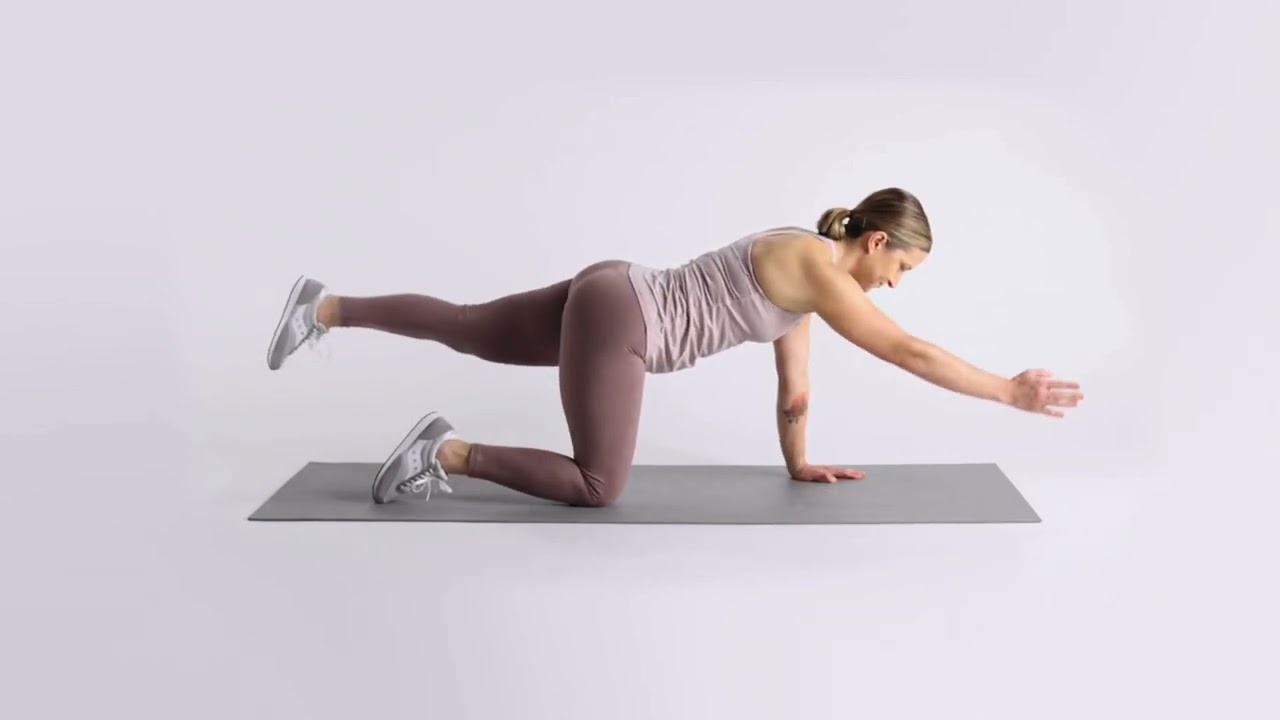
The bird dog exercise builds spinal stability while introducing balance and body coordination. It’s a great exercise for beginners who are starting to improve their core strength. It also works all of the posterior chain muscles in your back without putting too much pressure on your lower back.
Resistance bands, wrist or ankle weights and dumbbells can all be added once you’ve mastered the basics.
Here's how to do it:
- Start on your hands and knees.
- Extend one leg and the opposite arm.
- Keep your pelvis level and your spine stable.
- Hold for 3–5 seconds, then switch sides.
- Repeat 5–8 times per side.
3. Pelvic press

The pelvic press, also known as a shoulder or glute bridge, is one of the most common and popular Pilates exercises. Risa explains that it “connects the abdominals with the glutes and hamstrings while teaching you to maintain pelvic control”.
Make sure you don’t arch your back while you’re doing this exercise. The core should be engaged, spine neutral, and pelvis slightly tucked under.
Here's how to do it:
- Lie on your back with your knees bent and parallel.
- Inhale. Tilt your pelvis toward the ceiling and slowly roll up, one vertebra at a time, until you reach approximately your waist level.
- Focus on feeling each vertebra roll up sequentially.
- Hold for a moment or two, then exhale and slowly lower back down, one vertebra at a time.
- Repeat 5 - 6 times.
