I tried Joe Wicks' menopause workout - it's a low-impact, effective way to boost muscle and bone strength in just 20 minutes
I can confirm Joe Wicks' menopause workout is trending for the right reasons. Regardless of your fitness level, you can experience the benefits.


Joe Wicks has been a constant on television screens and online over the last decade, holding our attention with dumbbell strength training workouts and easy-to-follow recipes. In recent years, he's turned his attention to helping women going through menopause who are looking to adjust their workout routine.
The Strength in Menopause series is four short workouts, available to view on YouTube and his Body Coach app. They've racked up half a million views over the past few months. Joe himself says the workouts are mood-boosting sessions designed to address some of the more common symptoms of menopause, like low energy, a slowing metabolic rate, and muscle and bone density loss.
Being low-impact and requiring minimal equipment, it looks promising to me. But are they worth trying? Or is it just another way to make money from menopause? I tried the first two workouts for a week to find out.
I tried Joe Wicks' menopause workouts
I’ve been doing strength training for a few years now. I started with a brilliant female PT, who helped me build confidence to go to the gym alone, so now I plan my own sessions. On first glance, with just five moves in each, I thought Joe Wicks' menopause workout would be a bit simple for me. How wrong I was!
These routines set my muscles on fire, and the dreaded DOMS set in for days afterwards - partly my fault for jumping in without a proper warm-up or cool down after being away from the gym for a while.
Speaking of jumping, there isn't any. These workouts are built around compound movements like squats and lunges that keep at least one foot on the ground at all times, which is great for beginners and those dealing with achy joints in menopause.
That being said, these workouts are still very much a challenge. Joe’s signature on-screen clock caught me out more than once. The (somewhat relentless) movement of 40 seconds on, 20 seconds off, continuous for 20 minutes, revealed how easy I'd been going on myself during my self-managed gym sessions. Clearly, my rest periods were getting a little too long. The workout was enough to raise my heart rate into zone 3, which is rare for my usual zone 1 or 2-only strength workouts.
The four workouts consist of two upper-body workouts and two lower-body workouts. On first go, however, because I had an hour planned for the gym, I attempted both workouts back-to-back. I only made it halfway through the second one before admitting defeat. The intensity was a little too much to do them back-to-back.
However, at just 20 minutes each, combining both gives you a full-body workout in 40 minutes. One workout alone is enough for beginners or for anyone returning to strength training after some time away.
The exercises in the menopause workout will be familiar to anyone who's done strength training before, but it was useful to have Joe shouting out form and technique tips through the workout. He reminded me to go slow and controlled, rather than just trying to get in as many repetitions as possible. It's better for building strength.
Most of all, you get Joe’s undeniably upbeat attitude and cheery encouragement throughout, as well as moments of realism. Even super-fit Joe has to drop a kilo or two when he finds himself struggling at times, assuring us that we too can swap the weights or even revert to bodyweight if that feels right.
What do the workouts involve?
Workout 1: Upper body
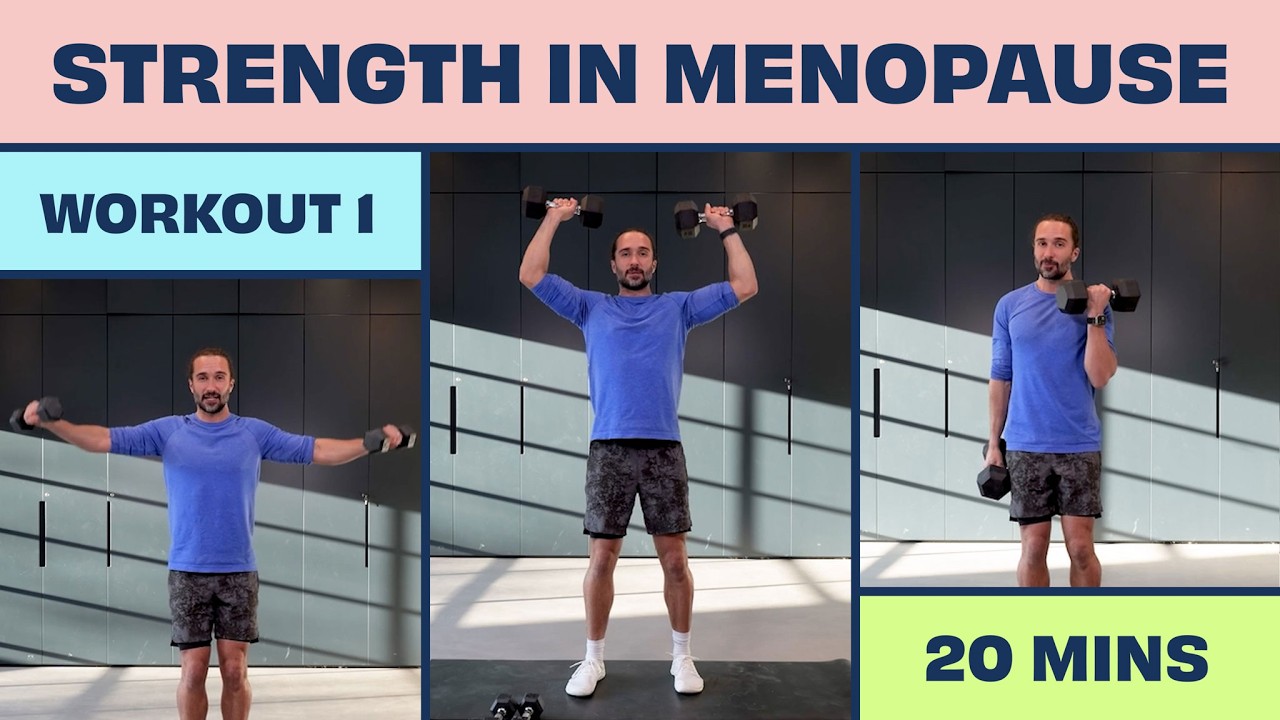
Have a pair of heavy weights and a pair of lighter weights to hand. Do each exercise for 40 seconds, with 20 seconds rest in between each.
- Bicep curls (with heavy weights): Lift each arm in turn, rotating each dumbbell as you pull up. Go slow and controlled rather than swinging them up and down.
- Shoulder press (heavy weights): Rest weights on your shoulder with elbows bent. Push up into full extension above your head, then take them back to your shoulders.
- Bent over rows (heavy weights): Hinge at the hips with a slight bend in the knee. Maintain a straight back (if this is tricky, don’t bend as low), and pull the weights up as you squeeze your shoulder blades together. Pause before dropping the weights down again, with control.
- Overhead tricep extension (lighter weights): Holding each weight behind your head, keep elbows tucked in. Then straighten arms to push the weights up overhead, and back down again.
- Lateral dumbbell raises (lighter weights): Take your arms out wide with a slight bend in the elbow, lift to shoulder height, then pause before slowly dropping back down.
- Repeat those five moves three more times (i.e. four times in total over 20mins).

You can do Joe's menopause workouts using your body weight, but if you intend to do them for long, you'll need a pair of good dumbbells like these from HOMCOM. They are the woman&home top pick thanks to their affordable price and practical shape.

An adjustable set of dumbbells is a good way to save money and space, as you can take the plates on and off safely to scale the weight up or down. It means you can use them for upper- and lower-body workouts very easily.

Otherwise, you can scale the weights up or down with different dumbbells. This set is great for beginners, ranging from 1kg to 3kg. It comes with a handy storage rack to keep the weights out of the way as well.
Workout 2: Lower-body workout
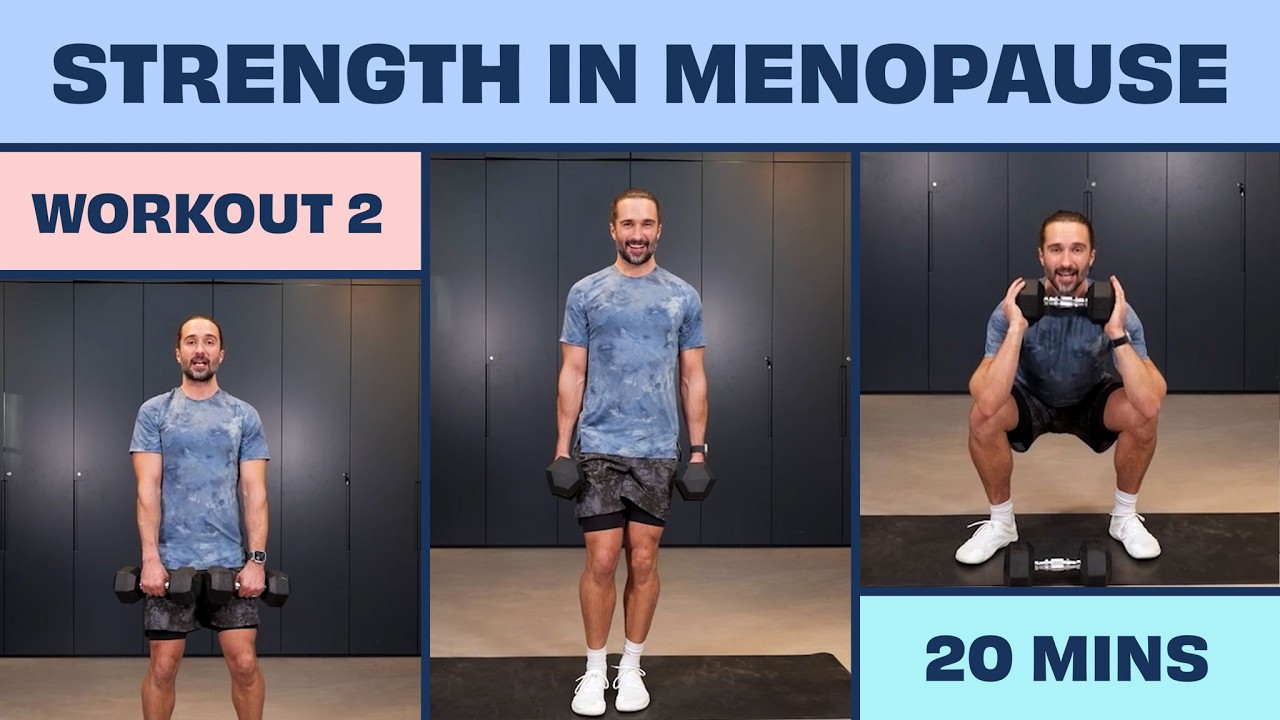
Use one set of heavy weights for all moves. Do each exercise for 40 seconds, with 20 seconds rest in between each.
Here's how to do it:
- Sumo goblet squat (one weight): Take the legs wide, toes turned out, and with one heavy dumbbell in hand, squat down (remembering to keep your back straight) and push back up.
- Reverse lunges (right side): With a dumbbell in each hand and keeping an upright position, step the right leg back with knee dropping (but not touching) the ground. Return to centre before repeating.
- Reverse lunges (left side): Repeat as above with the left leg.
- Romanian deadlifts (RDLs): With a dumbbell in each hand and feet hip width apart, make a slight bend in the knees before hinging at the hips and sliding the dumbbells down your legs, before returning to standing. Push your glutes out as you bend, ensuring you maintain a straight back throughout.
- Dumbbell front squat (one or two weights): With a dumbbell in each hand and feet hip-width apart, squat down while keeping your back straight, before returning to standing. Switch to one dumbbell if two is a struggle.
- Repeat those five moves three more times (i.e. four times in total over 20mins).
Benefits of the Joe Wicks' menopause workout
1. Builds muscle and strength
Between the ages of 30 and 50, women lose three to eight per cent of their overall muscle mass each decade. This decline speeds up as oestrogen declines during menopause, with women over 50 experiencing a five to 10 per cent loss of muscle mass every decade. Lower levels of oestrogen also impact muscle repair and recovery. Luckily, you can slow this decline with strength training.
“Joe’s exercises work well here,” says Edwina Jenner, a personal trainer and strength coach specialising in fitness for over 40. “Squats, lunges and RDLs are compound moves that recruit a large amount of muscle in the legs and glutes. Strengthening our glutes, the biggest muscles in our body, matters, as modern life keeps us sitting so much.”

It's helpful to have two sets of dumbbells for Joe Wicks' menopause workout if you're using weights. One heavy set and one lighter set, or some adjustable dumbbells.
2. Improves bone health
Oestrogen is essential for maintaining bone strength, so when it declines in perimenopause and menopause, our bones weaken. It leaves us at higher risk of fractures. In fact, the Royal Osteoporosis Society estimates that one in two women over 50 will break a bone due to osteoporosis.
There are measures you can take to reduce the risk, such as HRT, a balanced calcium and vitamin D-rich diet, and exercise. “Strength training helps because bones respond to mechanical loading,” explains Edwina. “When muscles pull against bone while lifting weights, this provides a stimulus that helps maintain bone strength. Squats, RDLs and lunges are particularly useful, as they load the hips and lower body, and strengthen the muscles around them.”
Joe’s menopause workouts won’t provide everything you need to build stronger bones. Edwina recommends jump squats or walkout jump-ups as a good addition to your routine.
But she also says: "Not every woman needs to start jumping. Pelvic floor symptoms and joint issues can be common in midlife, so impact exercise needs to suit the individual."
3. Boosts energy levels
With hormonal changes leaving you feeling like a drained battery, it’s hard to muster enthusiasm for a workout. But exercise will give you that much-needed boost, pumping oxygen-rich blood around the body and brain, and in turn, activating the cell-based mitochondria that produce energy.
For a quick energy-boosting opportunity, Joe’s workouts are accessible at just 20 minutes. It doesn’t take loads of time or mental energy to get it done, says Edwina. “When you’re tired, a long, intense workout can feel like another mountain to climb: this is where Joe’s uncomplicated 20-minute format works really well.”
If motivation is low, focus on tangible outcomes. “Strength training [is about] getting stronger and seeing what your body can do, rather than always making exercise about weight loss. At this stage of life, we need to build a robust, strong body that carries us into the future and protects our independence and autonomy as we age,” adds Edwina.
4. Improves cardiovascular health
Improving cardiovascular health is crucial in midlife as oestrogen, which protects the heart, starts to decline, putting women at higher risk of heart disease and heart attack. Joe’s workouts are slow and steady, rather than full of HIIT-based moves, but that doesn’t mean your heart rate won’t rise (as I discovered).
Commenting on Joe’s routines, Edwina says, “Repeated squats and presses with a challenging pair of dumbbells for 40 seconds, with only 20 seconds of recovery, can send your heart rate climbing considerably.”
Strength training alone isn’t enough to fully replace aerobic exercise, however. Ideally, women should do both.
5. Increases confidence and mood
Low mood and anxiety can be common in perimenopause and menopause thanks to fluctuating hormones. Add in lack of sleep, aching joints and an overwhelming schedule, and mood can worsen. Time and again, research has shown that exercise, which releases endorphins, dopamine and all the other feel-good hormones, can go a long way in lifting us, even when we really don’t feel like doing it.
In fact, a review published in Psychiatry Research found that strength training had, according to numerous studies, a moderate to significant antidepressant effect on people with depression.
Joe has long been an advocate for the mental health benefits of exercise, and that’s emphasised here in his menopause series. As Joe says in workout one, “Regardless of what stage of life you’re in, you’ll always feel better after exercise.”
Are Joe Wicks' menopause workouts worth doing?
Yes, I found Joe Wicks' menopause workouts to be challenging and time-efficient, equally as good for beginners as those who've been working out for a while, since each exercise can be progressed up or down.
Despite his popularity, Joe hasn’t been immune to criticism in the past, and the same goes for his menopause workouts. Some may view these sessions as a cynical ploy to tap into a large, health-aware, midlife audience (‘how can a 40-year-old man relate to the menopausal experience?’, some have said), but I believe that’s unfair.
Sure, coaching by a midlife female PT adds an extra layer of empathy and understanding, but when you solely focus on the movements, they are beneficial for women experiencing perimenopause.
PT Edwina believes Joe's got it right. “Joe Wicks has put together a well-rounded, simple and accessible 20-minute workout routine that removes a key barrier to exercise: finding the time. The format builds confidence without constantly changing sets, which is reassuring for women new to lifting," she tells me.
What's more, he sticks to the essentials. "[Effective] strength training is really about ‘rinse and repeat’: repeating the same movements builds confidence and technique rather than requiring you to learn something new. The basics, done well and repeated consistently, then made progressively more challenging, are what ultimately builds strength,” she explains.
Joe seems genuinely keen to learn more about perimenopause and menopause, and how fitness could improve women’s physical and mental health with age. He also brings his extensive fitness knowledge, encouragement and ‘can-do’ attitude to these exercises, reminding us to “keep believing in yourself”.
Tips for doing Joe Wicks' menopause workouts
- Practice progressive overload: You can't continue to build muscle unless you make your workouts harder over time. “If you can comfortably finish each 40-second interval, your weights are too light. The final reps should feel hard while form stays good," says Edwina.
- Experiment with weight on the first try: I found that I could go heavy on squats and bicep curls, medium for overhead presses, but much lighter on tricep extensions and lateral arm raises.
- Don’t skip the warm-up or cooldown: Even if you’re a seasoned lifter, these (seemingly simple) dumbbell workouts will leave your muscles burning if you don’t prep your body properly, particularly if you’re returning to exercise after prolonged time out from your routine. Gentle stretching, a roller and a massage gun can help here.
- Listen to your body: A bad night’s sleep, poor nutrition, stress. Add hormonal fluctuations into the mix, and you know that how fit and strong you feel can differ greatly, day by day. Edwina says, “On tired or low-energy days, you can still train using lighter weights. It’s about meeting your body where it’s at. Consistency matters far more than smashing every session.”
